
I’ve recently come across a brilliant piece of Scriptural manipulation to “prove” that the cross is a valid and powerful symbol to be used by all who believe in the death and resurrection of Y’shua the Messiah. How people can just keep on proving things from Scriptures, simply because within their religious understanding they NEED it to be authentic, is mind-blowing! In this case, the passage is Yechezqel (Ezekiel) 9:4, where these words are found: “and Yahweh said to him, “Pass on into the midst of the city, into the midst of Yerushalayim, and you shall put a mark on the foreheads of the men who sigh and cry over all the abominations that are done within it.” So the idea here is to put a mark on the foreheads of those who are faithful to Yahweh and have had enough of the abominations in the world of those days. What kind abominations are being referred to? If one starts reading at the previous chapter, Yechezqel 8, it becomes clear that the most prominent of these abominations that the prophet had in mind was the so called weeping for Tammuz. Tammuz is one of the major ancient pagan deities, extremely prominent in Babylon, and is, among others, identified as the god of fertility and also the sun-god. The custom that the Yehudim had taken over from surrounding heathen nations was to have a ceremony around the month that we know as June, and that they have subsequently called “Tammuz”, whereby the women, in particular, would mourn over the death of Tammuz. Tammuz, also known as “Adonis”, and the lover of Venus (also known as “Ishtar”), is believed to have been killed by a wild boar in the mountains of Lebanon. This is the reason, they believe, why the waters of the Adonis river had a reddish colour every year around the time of the month of Tammuz – it was red with the blood of Tammuz. The custom was to alternate excessive weeping over the death of Tammuz with excessive jubilation, for it was believed that at a certain time each year, Tammuz came back to life again, only to die again, as part of a never-ending circle.
Where does the symbol of the cross come into all of this? The Hebrew word used in Yechezqel 9:4 for “mark” (“put a mark on their foreheads …”) is the word “Tau” or “Tav”, which, incidentally, is also the way one would pronounce the last letter of the Hebrew alphabet – as in “the Aleph and the Tau”. The symbol for the modern Hebrew letter “Tau” is a ת but previously it had been X and was sometimes also written as a +. So, strictly speaking, at some stage or other, all three of these symbols have been used to indicate the letter Tau. But the fact is, Yechezqel 9:4 is not saying that a letter of the Hebrew alphabet had to be put on the foreheads of the faithful ones – it is saying that a mark had to be put on their foreheads. “Tau” is also an ordinary Hebrew word meaning “mark” or “sign”. What exactly this mark is, is not specified here. But throughout the ages people could not resist the temptation to see in this verse a green light for priests and church officials and even ordinary believers to put the sign of a cross on the foreheads of those they wished to bless or pray for. And they would support their view by statements such as: “Is Y’shua not called the Aleph and the Tau?” and “Does the word Christ in Greek not begin with the letter X?” and “Did the Messiah not die upon a cross?” This, once again, puts before us the question of the cross. Where does the idea of the cross come from; did the Messiah in fact die on a cross and is the cross a valid symbol of our belief?
I received an email this week with a teaching from a Messianic teacher who refers to the fact that the utensils used in the tabernacle of Mosheh were arranged in the shape of a cross. This, he says, was teaching us something about the cross of Messiah. He mentions the fact that the cross is the Tau, the last letter of the Hebrew alphabet, and that it carries the meaning of self-denial, or the willingness to be last. The first letter of the Hebrew alphabet, the aleph, he says, was previously represented by a symbol that resembles a bull. So if you put these two together, the Aleph and the Tau, you get a bull or an animal sacrifice and a cross – and whalla – there you have a picture of Y’shua (the Aleph and the Tau) dying on a cross. I am just wondering if this teacher had ever taken the trouble of trying to find out where the cross really comes from.
It is quite clear that the cross is an ancient symbol with its roots firmly in all kinds of pagan practices and beliefs. Interestingly enough, one of the most prominent figures associated with the cross, is the Babylonian Tammuz, the son of Nimrod and during the time of Y’shua’s death and resurrection the letter T was a well known symbol of Tammuz, according to several sources. Here are just a few examples of crosses being used, long before the birth of Messiah:

The Messianic Scriptures tell us that Y’shua was executed on a “stauros”, which mean an upright pole or a stake and this was the way the majority of Roman executions were done in those days – affixing the accused to an upright pole with his hands nailed to the pole above his head. It is not impossible that, in some cases, the Roman soldiers may have used an additional post to make this “stauros” assume the shape of a cross, but there is absolutely nothing in the Messianic Scriptures that forces us to believe that Y’shua was executed on such a cross-shaped structure.
History also records that after Constantine’s so called conversion experience in which he supposedly saw “the sign of Christ”, the cross symbol became the major symbol of Christianity and subsequently an icon of great spiritual, emotional, religious and artistic importance. 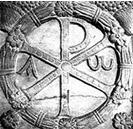 The “sign of Christ” that Constantine saw in the sky was the “Christ monogram”, also known as the “Chi-Rho” or the Labarum, which is generally believed to contain the first two letters of the Greek form of “Messiah” (“Christ”). But this entire conversion experience rests upon an extremely shaky foundation – given the fact that Constantine never managed to part with his involvement with paganism and sun-worship, in particular. And moreover, the sign that he saw, is a sign that was known already in the pagan world and had a completely different meaning to the one Constantine sent into the world.
There is a number of references in Scriptures that believers are to be marked with a sign, indicating that they belong to Yahweh or that they are faithful to Yahweh. It is my conviction that this sign is NOT the cross – in fact, it is not even a more valid symbol like the menorah, or a Torah scroll or something similar. It is not something that one can touch or feel or make an image of. Yahweh never intended for us to make a representation of our devotion to Him by using a symbol or image of this world. He did, however, give us a number of things that should serve as a sign for others to see and to know that we belong to him. One of these things is the Shabbat. No less than four times in Scriptures do we read that the Shabbat is a sign (Hebrew: “ot” – consisting of two letters: an “aleph” and a “tau”). Two of these verses may be found in Shemot (Exodus) 31and two more in Yechezqel (Ezekiel) 20. A sign of what? A sign that we love Yahweh, that we honour his commandments, that nothing is more important to us than being obedient to Him, that we are set-apart for his Name, that there is, in fact, something that makes us unique and different and set-apart in this world. We do not, and should not, have an iconic symbol that one can draw on a piece of paper or signify with your hands or put up in front of a church. But we have the Shabbat. Let us not let go of this sign. Let us not neglect it. Let us never forget the great importance of this sign.
Views: 548