
The eight days from the 25th day of Kislev (ninth month of the Jewish calendar) to the 3rd day of Tevet (tenth month of the Jewish calendar) is traditionally set aside for the Feast of Chanukah, also called the Feast of Dedication, or the Festival of Lights. If we go according to the calendar based upon the Scriptural months and seasons, this feast started two days ago on Thursday 2 December 2010. Chanukah has its roots going back to the time of the Second century BCE Sirian king Antiochus IV (called Epiphanes – “god [Zeus] in human form” – by the Greeks, but later renamed by the Jews to Epimanes – “madman”). In a sense, one may look even further back for the roots of this festival – to the time of Alexander the Great who conquered Syria, Egypt and Babylonia in 333 BCE. It is said that when Alexander marched through Jerusalem he asked the high priest to erect a statue in his honour within the temple. The high priest, who realised how important it was to maintain good relations with this mighty man, answered that this could not be done but instead the Jews would name all their first-born sons after the great king. Alexander agreed and consequently got along with the Jews quite well.
One and a half century later, during the time of the Syrian king Epiphanes, matters have changed considerably. This Epiphanes, or Antiochus IV, appointed his own “high priest” for the temple, prohibited the study of the Torah, outlawed practically all Jewish traditions, desecrated the holy of holies and ordered pigs to be offered on the altar. No wonder he was hated and called “madman” by the Jews. In 165 BCE the Jewish/Hasmonean family of Mattityahu the high priest and his son Judah Maccabee (“the hammer”) started a revolt against the Syrian-Greeks. They managed to bring some sort of relief for the Jews and, among other things, liberated the temple in Jerusalem. However, the temple needed to be set apart again and rededicated in order to comply with the standards and requirements of Torah.
Oil that was not desecrated by the pagans was desperately needed. According to tradition, there was only one day’s supply left of this and it would take 8 days to prepare a fresh supply of oil for the menorah. Miraculously, this small quantity of oil kept the menorah burning for 8 days, until the new supply was available and consequently an eight day festival was declared to commemorate these miraculous events. The nine arm menorah became synonymous with the festival of Chanukah, together with the tradition of starting with one candle and adding one more candle on each night of the eight day feast, to be kindled in combination with the middle candle, called the “shamash” or the servant candle.
Scripturally speaking, the keeping of the feast of Chanukah is not a mitsvah or a requirement for those who wish to honour the Word of Yahweh. I don’t think that (non-Jewish) Messianic or Torah observant believers should feel themselves obliged to, or allow others to bully, or guilt-force them into, formal observance of this festival. What this feast stand for, however, is a confirmation of certain principles and truths of Scriptures that are worthwhile remembering, or being reminded of. For this reason alone, those who prefer not to observe Chanukah, should not be critical of those who feel more strongly about this feast and prefer to observe it alongside the other Scriptural feasts. It is worth mentioning that it is recorded in Yahuchanan 10:22-24 that Y’shua attended this festival and made use of this opportunity to reveal a number of critical truths with regards to his own identity, the calling that He had received and the relationship between Yahweh and Himself:
Joh 10:22 At that time the Chanukah came to be in Yerushalayim, and it was winter. And Y’shua was walking in the Set-apart Place, in the porch of Shelomoh. So the Yehudim surrounded Him and said to Him, “How long do You keep us in suspense? If You are the Messiah, say to us plainly.”
Seeing that we are in the period of this feast right now, let us look at some of the more important truths that are connected, in some way or other, to the feast of Chanukah.
1. The set apart things of Yahweh should never be desecrated and trampled upon by boastful, sinful and arrogant men.
Exo 20:3-5 You have no other mighty ones against My face … You do not make for yourself a carved image … you do not bow down to them nor serve them. For I, Yahweh your Elohim am a jealous El.
2. Nothing is impossible for those who put their trust in Yahweh and prefer not to be disheartened by human reasoning and the natural order / scheme of things.
Jer 32:27 See, I am Yahweh, the Elohim of all flesh. Is there any matter too hard for Me?
3. When Yahweh hears the petitions of his people and answers prayers miraculously, honour should be given where honour is due.
Psa 66:16 Come, hear, all you who fear Elohim, And I relate what He has done for my being.
4. When it comes to being subjected under an authority that disregards Yahweh’s authority, we need to be obedient to Yahweh, above all.
Act 4:19-20 But Kepha and Yahuchanan answering them, said, “Whether it is right in the sight of Elohim to listen to you more than to Elohim, you judge. For it is impossible for us not to speak of what we saw and heard.
5. In our day, Yahweh chooses to reveal Himself and his greatness through a temple that is not made with hands, but of equal, if not superior splendour.
1Co 3:16-17 Do you not know that you are a Dwelling Place of Elohim and that the Spirit of Elohim dwells in you? If anyone destroys the Dwelling Place of Elohim, Elohim shall destroy him. For the Dwelling Place of Elohim is set-apart, which you are.
6. Burning oil (offering prayers) before the face of Yahweh continually, is something that no true believer should ever neglect or regard as unimportant.
1Pe 2:5 You also, as living stones, are being built up, a spiritual house, a set-apart priesthood, to offer up spiritual offerings acceptable to Elohim through Y’shua Messiah.
7. Y’shua is the true light (“shamash”) of this world and no form of revelation, outside of Him, will ever make a lasting impression on people’s lives.
Joh 8:12 Therefore Y’shua spoke to them again, saying, “I am the light of the world. He who follows Me shall by no means walk in darkness, but possess the light of life.”
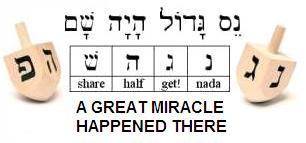
** Traditional Chanukah game: “Dreidel” played with four sided top.
Views: 23