
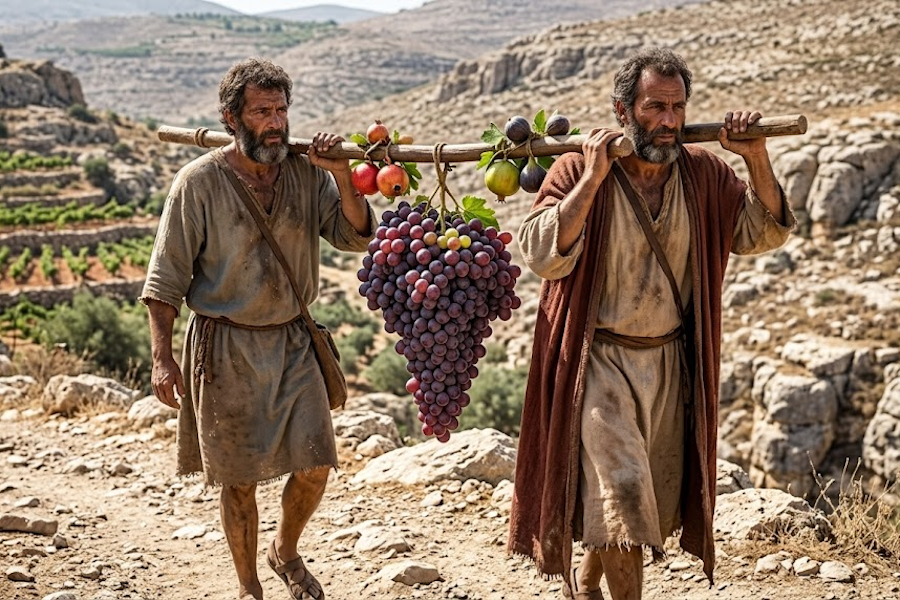
One sometimes forgets that the 40-year period that the nation of Yiesraél spent in the wilderness had a very specific origin. It was announced when the 12 spies returned from the Promised Land and 10 of them painted an absolute negative and terrified picture of the land. It was then that Yahweh said: “According to the number of the days in which you spied out the land, forty days, for each day a year, you shall bear your iniquities, forty years” (Num 14:34). Some commentaries describe the motive behind this exponential increase from 40 days to 40 years as follows: “Thereby, they shall know by sad experience the evil of complaining and murmuring against Yahweh”. Besides the 40-year wilderness sentence, there were further repercussions: Not one of the generation that rebelled would enter the land. Only their children, together with Joshua and Caleb, would inherit the Promised Land. And the ten spies who brought the negative report would be killed immediately by a plague. And on top of that: When a part of the nation tried to fight open a way for themselves to the Promised Land the next day, directly against Mosheh’s word, they were decisively defeated by the Amalekites and Canaanites, simply because Yahweh was not with them.
Zechariah 8, with a total of 40 mentions of the Name Yahweh or his words, connects very strikingly with the theme of the spies and the 40 days that became 40 years. Numbers 14 tells us that after the return of the spies, the nation wept for a whole night. Some rabbis believe that this was the night of the darkest day of the year, Tisha B’Av, And that the nation wept for nothing that night. This is why Tisha B’Av later on, at regular intervals, became a night (and a day) in which the nation had abundant reason to weep. Two temples destroyed – 655 years apart. A massacre with the Bar Kokhba Revolt in the year 135, which led to the expulsion of Jews from their own land for 1800 years. The expulsion of Jews from England in the year 1290. The expulsion of Jews from Spain in the year 1492. And the beginning of the mass deportation of Jews from the Warsaw Ghetto, in 1942 during the 2nd WW, to punishment camps where they would eventually be killed. Everything on, or very close to, the day of Tisha B’Av. And Zechariah 8 probably refers to this day when it speaks of the fast of the fourth month, the fifth month (Av!), the seventh month, and the tenth month. Most Scripture commentators believe that these 4 fast days may all be linked to the events surrounding the beginning of the Babylonian Exile and the destruction of the first temple in the year 586 BCE.
Zechariah brings a message of hope and redemption to this nation that knew every detail of the spies and the betrayal of the 10, the grapes and the drama of the giants and the walls, and the wilderness and the resistance of the masses. They know all too well about the older people who perished in the wilderness and the younger generation, or remnant, that entered the Promised Land. Therefore, he uses concepts like vineyard and fruit and old men and old women and young children and remnant. But his message differs like night and day from what happened in Bemidbar (literally: “in the wilderness”). Yahweh is going to do something new! The cluster of grapes no longer contains a seed of unbelief as before, but a seed of promise and peace. Previously there was fear and confusion and curses and fast days. But at a time that Yahweh has determined, there will now be safety and redemption and cheerfulness on a large scale. And listen to this: Ten men from all the languages of the nations (the same number as the ten spies who did not stand in the same camp as Joshua and Caleb), will grab the hem of a Yehudite man (like Caleb) and hold it fast and say: We want to go with you, for we have heard that Elohim is with you. This is something that only Yahweh can do. Only He can change a person’s fast and fear into a feast of steadfastness. And is it not remarkable that Joshua was of the tribe of Ephraim, and Caleb was of the tribe of Yehudah! That the two faithful spies were representative of the two groups that would later spell out the division within Israel, but prophetically already contained the message that Yahweh will totally wipe out that division – to the point that ten men (in other words: thousands of people) from the world’s languages and nations, representative of the lost ten tribes of Israel, will come, stripped of their pride, and say to a Jew: There is something irresistible that connects me to you!
In the book of Bemidbar or Numbers, the ten spies looked at the giants and the fortified walls of the cities in the Promised Land, and even at the large cluster of grapes, with physical eyes, NOT with eyes of belief. The one book in Scripture that has encouraged believers through the centuries to look at their circumstances with eyes of belief is the book of Hebrews. The word “Hebrews” comes from a word that means “to cross over” (just as Avraham crossed the Euphrates river and the Israelites later crossed the Jordan river) or “to go and stand on the other side”. The first person to be called a Hebrew is Avraham. The Jewish commentators say Avraham is not only called a Hebrew because he crossed the Euphrates river to go to the land that Yahweh had designated for him. It also has a deep spiritual meaning: The whole world stood on one side and Avraham went to stand on the other side. In the world, people look with physical eyes. But Avraham looked with the eyes of belief and he was often the only one of his generation who had the courage to do so. Therefore, Hebrews 11 says Avraham waited for the city which has foundations, whose builder and maker is Elohim. That is why he is called the father of the believers. As believers, we should repeatedly show by our choices and our actions, like Avraham, that we are willing to go and stand on the other side and look through eyes of belief – not only at the giants and the walls before us, but also at the promise and the potential that can be locked up within a single cluster of grapes.
Hebrews 3 was written against the background of what happened in the wilderness when virtually the entire nation hardened their heart against Yahweh, because 10 spies planted a seed of unbelief in their midst. Nothing causes a person to fall away from the living Elohim so quickly as when you make room for an unbelieving heart, Hebrews 3:12 tells us. And let us not think for a single moment that such a mass demonstration of unbelief can no longer happen. That is precisely why Hebrews 3 quotes the words of Psalm 95 and explicitly says: TODAY, if you hear His voice, do not harden your hearts! It is today that you and I must also choose not to open the door for unbelief and hardness to creep into our hearts. It is today that we must choose, like Avraham, to go and stand on the opposite side as the belief-resistant part of the world. It is today that we must declare like Sha’ul (Paul): I forget the things that are behind and reach forward to what is ahead, to the high calling with which Elohim has called me, and which has everything to do with Y’shua.
And speaking of Y’shua. His Name is a derivative form of Yehoshua. Exactly the same name as the one who previously chose, along with Caleb, to look with the eyes of belief at the giants and the walls and the cluster of grapes, as the inheritance that Yahweh had measured out for His people. We saw earlier that this Yehoshua or Joshua was of the tribe of Ephraim, which is the designation that Scripture often uses to refer to the Northern Ten tribes, who were later carried away into captivity by the Assyrians and became mixed with the nations of the earth. And just as Yehoshua or Joshua previously had a kindred spirit in the form of Caleb beside him, who was from the tribe of Yehudah – symbolic of the essential unity between Ephraim and Yehudah in Yahweh’s eyes – just so, 1300 years after the earthly life of this Yehoshua, another kindred spirit (and a namesake!) is born to him – also from the tribe of Yehudah. And with this one’s birth, Yahweh comes to confirm anew that He absolutely carries the restoration and the unity of His nation on His heart. Y’shua did not only come to unite us with Yahweh. He also came to unite us with His restored and like-minded nation! He came to make us part of the true offspring of Avraham again. We do not know exactly how the relationship between physical Israel and believers from the nations will play out in the future. But we know that Joshua and Caleb-type belief will be decisive. And that Zechariah was spot on when he prophesied that people from all languages will look to the faithful Jews and say to them: We want to go with you for we have heard that Elohim is with you!
Views: 71
Please send me the link to the app